Options Guide
The SINCAL model output can be configured in a number of ways.
How to change model options
The current behaviour of the "⚙️ Options" button is counter-intuative. If you open up the options menu and change settings, then close the menu, these will NOT be saved.
The ONLY way to save configuration options is via adding a new preset. The Default profile CAN NOT be edited.
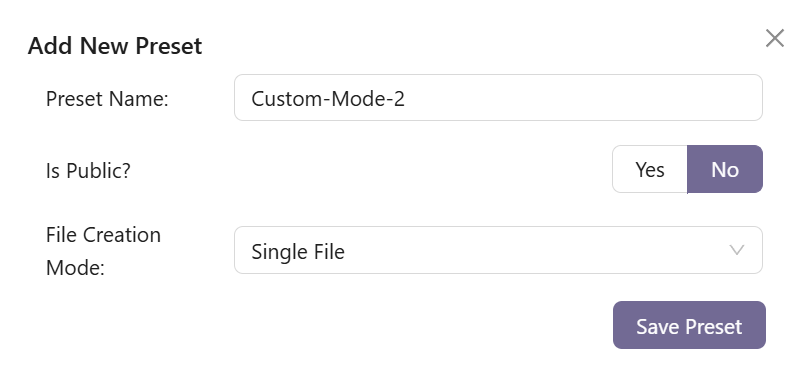
- Click "Add New"

- In the Add New Preset menu, assign it a sensible name, and choose other preset options, and then 'Save Preset'
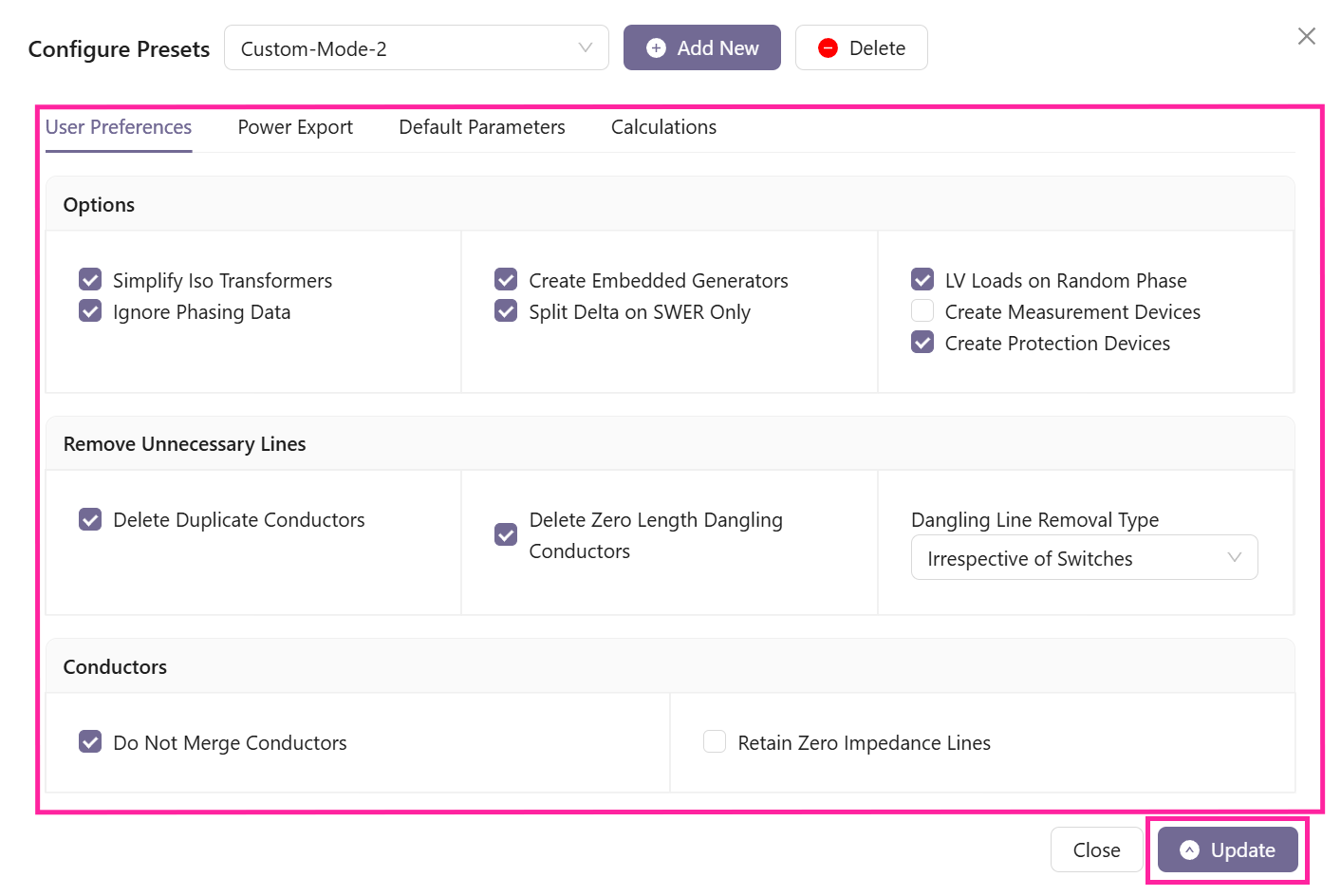
- With the new mode selected, change whatever options you need across all 4 Option Tabs (User Preferances, Power Export, Deault Parameters, Calculations), and then 'Update' to save the changes to the preset.
Options Detailed Explanation
Next we will detail the impact that each option has on the output and what the options mean.
User Preferences Form.
The User Preferences tab controls general options for the profile and the set up of the output SINCAL file. These options control the behaviour of the exporter when building the model, the output SINCAL version, the base template the SINCAL file is built from, and the local standard database used.
Options
Simplify Iso Transformers
TK
Ignore Phasing Data
The Ignore Phasing Data option will instruct the exporter to ignore any data on phasing coming from the source information. Instead, all lines and elements will be treated as three phase, unless they are a SWER isolator or in network downstream of a SWER isolator. This option is intended to be used in cases where incorrect phasing data in the source information is leading to problems within the exported file, or where a balanced network is required as the output.
Create Embedded Generators
Embedded Generation: Embedded generation options will place DC infeeders at distribution substations, where information about how much embedded generation exists within the distribution substation is available. To use this option, the selection for creating DER must be made within the export options.
Split Delta on SWER Only
If the Simplify SWER option is selected, SWER network (downstream of SWER isolating transformers) will not be included in the model, and a single load will be placed at the location of the isolating transformer, representing the sum of all downstream distribution transformer load. The load’s value will be set in different ways depending on the options set in the Power Export tab:
-
If the Smart Load option is set, and load data is available from the server, the load at the isolating transformer for the selected time will be used.
-
If the Transformer rating option is set, the load will be set according to the rating of the transformer. If utilisation data is available from the server for the isolating transformer, this will be set in the fS, fP and/or fQ fields as appropriate.
-
If the Zero load option is set, the load at the isolating transformer will be set to zero.
Using this option, in combination with the Ignore Phasing Data option can generate an entirely balanced network representation if this is needed.
If the Simplify SWER option is not selected, SWER network will be represented within the output file.
LV Loads on Random Phase
LV Loads on Random Phase is intended for use when modelling LV systems, where customers are connected directly to a three phase line, and are known to be single phase, but which phase they are on is unknown. Selecting this option will randomise the phase of the LV load, ignoring any data on phasing for the customer load that comes from the server. Due to the random nature of the phase generation, files created at different times using this option will apply different phases to the same consumers - ie. the load phasing will not be consistently generated. This option should not be used in cases where loads are all modelled at distribution transformers with no LV network modelled.
Create Measurement Devices
The option to Create Measurement Devices will, if checked, create a SINCAL measuring device (for use with the Load Assignment module) at infeeders and at the end/beginning of network zones. The measuring device will be off by default and not have any measured data associated with it.
TK The end/beginning points of network zones are identified according to the information specified for the Zone End Node Name Matching: see the description of this option under the Advanced settings section. TK
Create Protection Devices
If this option is selcted, Protection Devices will be created in the SINCAL model.
Remove Unnecessary Lines
Delete Duplicate Conductors
This option will remove duplicate lines, which are defined as lines with the same start and end points, same length and same impedance characteristics. This description might also cover parallel circuits in some cases, so deleting duplicate lines might not always be the correct option for your network. For this reason, the option is not checked by default, but users can enable it if they choose.
Delete Zero Length Dangling Conductors
A zero length dangling line is defined as a line that is only connected to the network at one end (ie. its far end is not connected to anything), and which has a length of zero. Such lines might exist as artefacts from the process of importing the data into the EWB server; short lines that were necessary in the originating system, but which just create clutter within SINCAL. These lines can be remo ved if the user would like. If the user would like to only do this for lines without any switches, or for lines without any open switches, these options are also available for selection under the Dangling Line Removal Type drop down.
Conductors
Do Not Merge Conductors
This option will prevent the exporter from combining similar lines together. Normally, to reduce the complexity of the output model, if two adjoining lines:
-
Are of the same impedance, rating and type; and
-
Do not connect to any third element at their common point of connection
They will be merged into a single line within the output SINCAL model. If this option is selected, the lines will not be merged, and the original number of conductors will be preserved in the output model. This can be useful if you wish to retain a 1:1 correlation with the original data source for the lines.
Retain Zero Impedance Lines
By default, and line that has all of its impedances set to zero will be treated as ‘suspect’ and have its parameters set to match those of the suspect line type specified. However, this behaviour can be overwritten by checking the Retain Zero Impedance Lines checkbox. If this box is checked, zero impedance lines will remain in the output network with their original data.
Power Export
Output mode controls how the power values are populated. The various options are explained here.
0 mode
The P and Q values will be zero for all loads.
Transformer rating mode
The P and Q values will be written using the nameplate rating (when available) of the transformer. If nameplate rating is not available, the export will use a smart load reading for the load (if this is available). If neither method is available, the load will be set to zero, and an error message will be generated. Depending on the EWB server, and the data that was used to populate it, utilisation information for the transformer might be available. If this data is available, it will be set in the fields fS, fP and/or fQ as appropriate for the load entry type.
The fields within the Transformer Name Plate Rating Configuration options will control how the rating is converted into a load:
Percent (%) Utilize sets the load to be a percentage of the nameplate value, and the Power Factor sets the power factor of the load.
Note that the utilisation information that might be available from the server is different from the % Utilize used as a program setting, and both will be applied if set.
Smart load mode
The P and Q values will be written using the power reading from the server for this distribution transformer at the time specified in the Timestamp field. The Load Retrieval Parameters frame controls the options for loads that are retrieved using this method. Using this method requires that load data be set up and available on your load data server for the date selected. Check with your system administrator if you are not sure about the availability of load data on the server.
Load Entry Type specifies how the load values are entered, which is a subset of the options normally available in SINCAL:
- P & Q
- S & cosphi
- P & cosphi
- S, cosphi and Voltage
In all cases except the last, the voltage value in the load will be set as a percentage voltage, with a value of 100%. For the S, cosphi and Voltage option, the voltage will be set to the load’s default voltage as a value in volts (eg. 11 kV or 22 kV).
The Load Behaviour field corresponds to the same field in the SINCAL load entry, which controls the relationship between the voltage at the load and the amount of power it consumes. The available options within the exporter allow the specification of constant power, constant current or constant impedance loads. See the SINCAL documentation for more information on how these options are used.
Default Parameters
Transformer Control Side
There are two settings, to either place the transformer controllers on the primary side or the secondary side of the transformers.
Infeeder Voltage Percentage
This gives the percentage of voltage that should be set for each SINCAL infeeder element.
Default Capacitor Size (MVar)
This gives the size for capacitors which are not linked to a standard type and do not have sizing information in the data stored on the server. The unit is in MVar, so a value of 1 would be a 1 Mega Volt-Amperes Reactive transformer.
Calculations
Load Flow
Type
The Load Flow Type and will set the corresponding parameter within the SINCAL Calculation Settings.
Network Level Line/Cable Temp.
Network Level Line/Cable Temp. (temperature) will set the value of Overhead Line Temp. (Tline) and Cable Temperature (Tcable) within the Network Level basic data for each network level (also called voltage level) that the SINCAL exporter creates.
Short Circuit
Type
The Short Circuit Type and will set the corresponding parameter within the SINCAL Calculation Settings.
Temp. at End of Short Circuit
The Temp. at End of Short Circuit value sets the field of the same name within the Short Circuit Calculation Settings. It does not set the field of this name (Tend) for each individual line section.
Voltage Tolerance
Voltage Tolerance will set the value of Voltage Tolerance within the Short Circuit tab for each network level (also called voltage level).
Advanced Options
There are some options of the SINCAL exporter tool that are not currently directly ediatable in the web version of the tool.
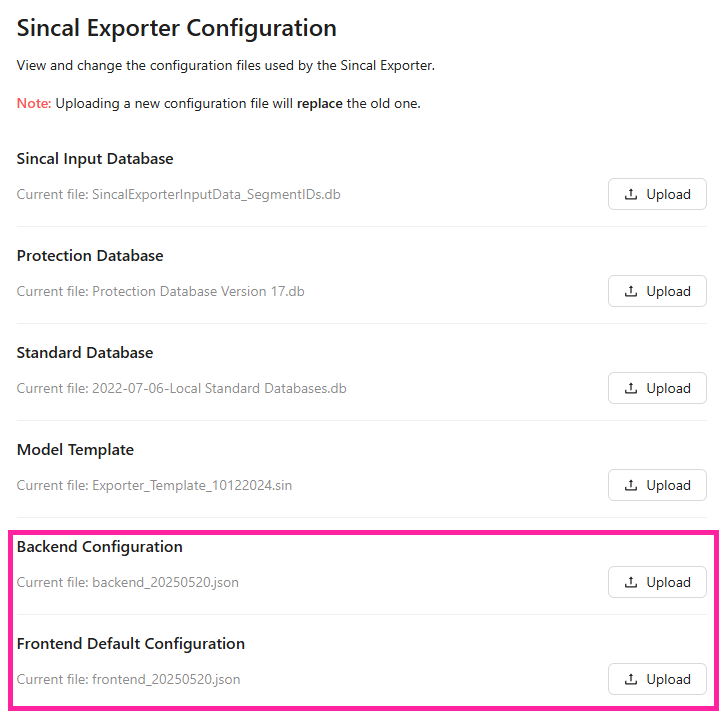
If you require these options to be changed, this can be done by exporting a profile in the desktop version, and uploading it to the Sincal Exporter Configuration section in the Admin tab.
If you require any of these settings to be changed on more than a once-ff basis, speak to Zepben about it, we may be able to add those options into the Web Version at a later date for your convenience.
How to export settings from the Desktop Version
In the desktop version, click the 'Edit'

- From the 'Default' profile, make a new profile via the 'Create New Profile' button.
- Give your profile a new name, and make any desired changes.
- Save the profile via the 'Apply' button.
- Export the profile via the 'Export Settings for Web Version". The export option is only available if the selected profile does not have unsaved changes.

This exports the currently selected profile to a directory, in two files, a front-end and back-end file. Each file will have the current date in their filename.
These settings can then be imported to the web version
Import settings from the Desktop Version
- Go to 'Admin' in the top bar:

- Select 'Sincal Exporter Configuration'

- Upload the backend and frontend files via the 'Upload' button. This will replace the old settings file.